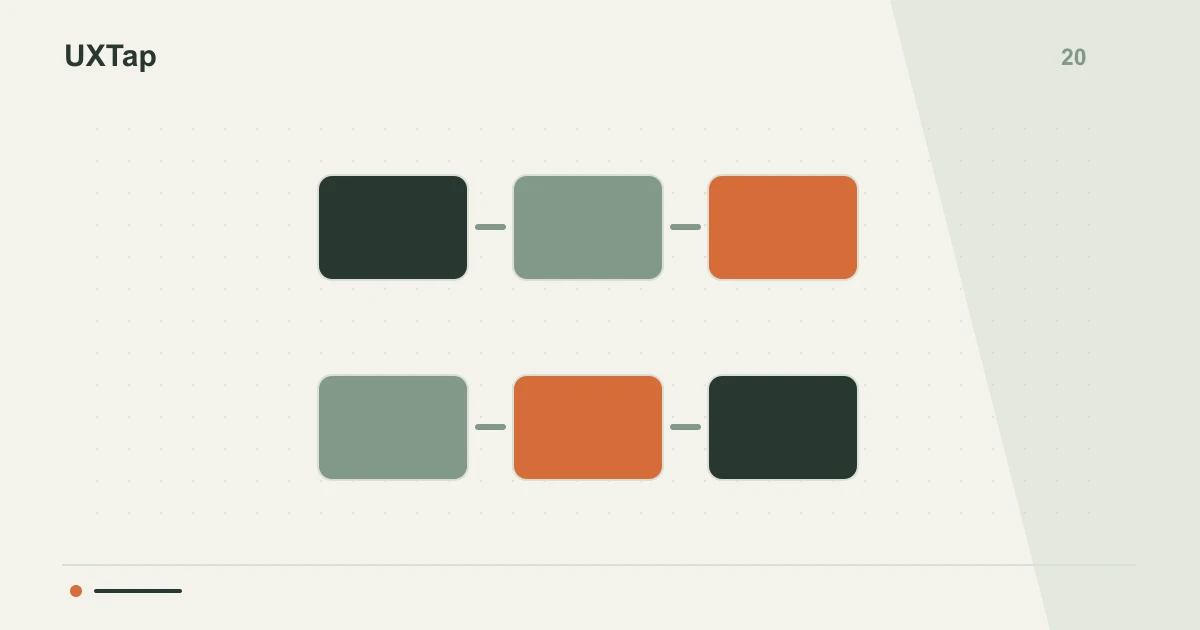
The sequence of tasks presented in a usability study can skew results. Users might learn or become fatigued, affecting performance on subsequent tasks. Ignoring this 'order effect' risks drawing inaccurate conclusions about the product or service's actual usability. Understanding and managing task order is essential for obtaining insights that truly reflect user interaction.
Independent vs. Dependent Tasks
For tasks not dependent on each other, like finding information on different pages, varying the order among participants allows the team to inspect how learning or fatigue might be distributed. This approach helps to balance out potential influences. However, for dependent flows, such as a sign-up or purchase process, maintaining the product's actual sequence is crucial. This simulates the authentic user experience, helping to identify issues within the intended flow without artificial shortcuts.
Recording Sequence and Context
Record the order actually presented, not just the planned sequence. In a hypothetical example, two independent tasks ask people to find a delivery policy and locate a support channel. Some participants receive the first task before the second; others receive the reverse order. Restore the same initial state between activities when the study design calls for it. This comparison can help investigate learning effects, without assuming that alternating task order removes every difference between participants.
Avoiding Prior Exposure Bias
Avoid directly comparing the performance of users with prior exposure to the system with that of new users. Prior familiarity with an interface or flow might obscure usability issues for beginners, making it seem easier than it is for a first-time user. If both groups are necessary for your research, analyze them separately. Alternatively, design the research to account for this variable, for instance, by comparing performance within each group over time in a longitudinal study to observe changes.
Key Steps to Address Order Effects
- Vary the order of independent tasks among participants to distribute learning.
- Maintain the actual sequence for dependent user flows to simulate reality.
- Always record the exact order of tasks performed for each participant.
Before your next usability study, review the task script carefully. Identify any dependencies between tasks. Based on this, create a documented task sequence plan, noting which tasks will be randomized and which must follow a fixed order. This plan serves as a concrete artifact to guide moderation and data analysis, allowing your team to inspect potential order effects.
Your next discovery begins with a question.
Test an idea, observe the experience and bring evidence to your team.
Create my first studyFree · 1 study · 50 responses/month · no card