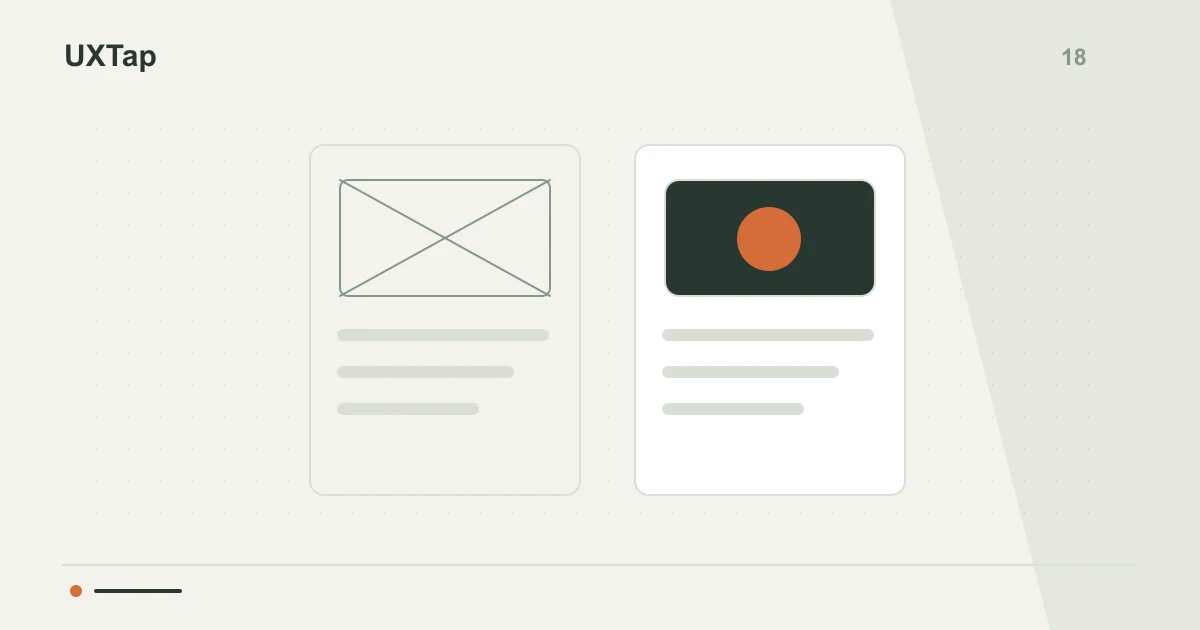
Many teams spend too much time detailing prototypes that don't need high fidelity, or, worse, create prototypes too simplified to answer their questions. The challenge is aligning the prototype's detail level directly with what you need to learn from the research, optimizing time and resources.
Align fidelity with your research question
Prototype fidelity should be a strategic decision, not a default. If your research question focuses on the usability of a complex flow, like password recovery, the prototype needs to convincingly simulate states and transitions. To test the clarity of a button label, a simple wireframe with the final text might suffice. Prioritize what needs to be real to inspect your hypothesis effectively.
System state and content accuracy
Consider what the user needs to see to interact. If you are testing a sign-up flow on a mobile phone app, the prototype must show input fields, error messages, and screen progression. For instance, in a hypothetical usability test for a new registration flow, the prototype should feature final text for fields and buttons, and simulate data validation so participants can experience the complete process.
Document prototype limitations
No prototype is perfect. It is vital to clearly document what the prototype does not simulate or faithfully represent. This helps the team accurately interpret research findings and avoid erroneous conclusions. For example, if the prototype lacks animations or microinteractions, note that the experience's fluidity was not evaluated, focusing only on core functionality.
Prototype fidelity checklist
- Define your research question before starting the prototype.
- Identify elements that need to be interactive or visually accurate.
- Document what the prototype doesn't cover to avoid bias.
Before building your next prototype, gather your team to explicitly discuss research questions. From those discussions, decide and document the necessary fidelity level for each component, creating a clear record of design decisions.
Your next discovery begins with a question.
Test an idea, observe the experience and bring evidence to your team.
Create my first studyFree · 1 study · 50 responses/month · no card